FAFSA
Updating UX & UI for the Free Application for Federal Student Aid’s 2025 - 2026 Rollout
Streamlined the FAFSA user experience, improved the AI tool Aidan, and introduced public experiences to reduce user confusion for the October rollout.
Project Summary
User personas, journey maps, web designs for FAFSA updates, and comps for user experience concepts.
Deliverables


See the full project breakdown below. ⬇️
Impact
My proposed FAFSA solutions were rated an average of 4.15 out of 5 by users.
Navigation Hub
My Role
Researcher and Designer
Google Scholar, Midjourney and Notebook LM
My Research Tools
Figma
My Design Tools
4 Weeks
Timeframe
FAFSA is the primary gateway to higher education, yet equity remains elusive. Applications from low-income, Black, and Latino communities are 2x more likely to remain incomplete. Despite federal reforms in 2020 (transitioning from EFC to SAI), technical failures in the 2024–2025 rollout put $1.8 billion in aid at risk.
A massive friction gap exists: post-revamp, dependent students averaged 5 days to complete the form, compared to independent students who finished in 15 minutes. To bridge this gap, I focused on optimizing Aidan, FAFSA’s AI assistant, which has already successfully managed 11 million messages.
My research identifies how to pivot Aidan from a reactive chatbot to a proactive tool that dismantles these systemic usability barriers.
The Context
How might we enhance the user experience of the FAFSA application ahead of the 2025–2026 release?
The Ask
Main Insight
FAFSA Processing Hinges on Financial Documentation
Dependency on guardian financial data creates a significant UX bottleneck. During the 2024-2025 launch, these documentation hurdles blocked 20% of all submissions, highlighting a critical need for streamlined data integration.
-
“After FAFSA Issues, Education Department Faces ‘Crisis of Credibility,” Inside Higher Ed
“Exclusive: The Education Department says it will fix its $1.8 billion FAFSA mistake,” NPR
“FAFSA Fallout: Application Dropoff Threatening to Widen College Gaps,” The Century Foundation
Kantrowitz, M. (2020, September 24). FAFSA application statistics. Saving for College. Retrieved from https://www.savingforcollege.com/article/fafsa-application-statistics
“Two years of Federal Student Aid’s virtual assistant lead to lessons learned and a clear vision of the work ahead.” Digital.gov
“Watchdog sheds light on FAFSA fiasco, from a birthday bug to call center failures,” LAist
“What factors influence the time it takes to complete the FAFSA form, and how can I minimize them?,” SharedWisdom
UX & Product Considerations
Initial context and research uncovered key factors that informed how I could improve the FAFSA user experience.
Due to recent extensive updates, another major FAFSA overhaul isn't feasible.
Existing tools—like the Aidan AI assistant—offer valuable opportunities for improvement.
Many users struggle with the financial section due to a lack of awareness about required documents.
Based on existing research, I developed two primary user personas to represent those most impacted by the FAFSA changes. Anne is the mother of Keisha, a dependent student. While they have different levels of tech literacy, both struggle with preparing the necessary documents for the FAFSA process.
Check out the mini slideshow below for a closer look at these users. ⬇️
User Personas


Phase 1: Pre-App Engagement (Building Trust)
To combat "application anxiety," I introduced Aidan—the FAFSA AI guide—months before the filing window. By leveraging non-traditional touchpoints, I shifted the brand's perception from "bureaucratic hurdle" to "supportive companion":
Spotify Partnership: FAFSA-themed playlists to keep deadlines top-of-mind.
ASMR Content: Calming YouTube soundscapes to lower the emotional barrier to entry.
Phase 2: In-App Optimization (Reducing Friction)
I pivoted Aidan from a reactive chatbot to a proactive, context-aware guide.
Real-time Assistance: Instead of waiting for a prompt, Aidan delivers step-by-step instructions at known friction points.
Cognitive Load Reduction: Instant answers are surfaced automatically, keeping users in the "flow" and preventing session drop-outs.
Explore Aidan’s ecosystem expansion below. ⬇️
Solution
FAFSA on Spotify, Reminding Users of Application Opening Date

FAFSA on Spotify, Reminding Users of Application Opening Date - In-Depth

FAFSA ASMR Partnership
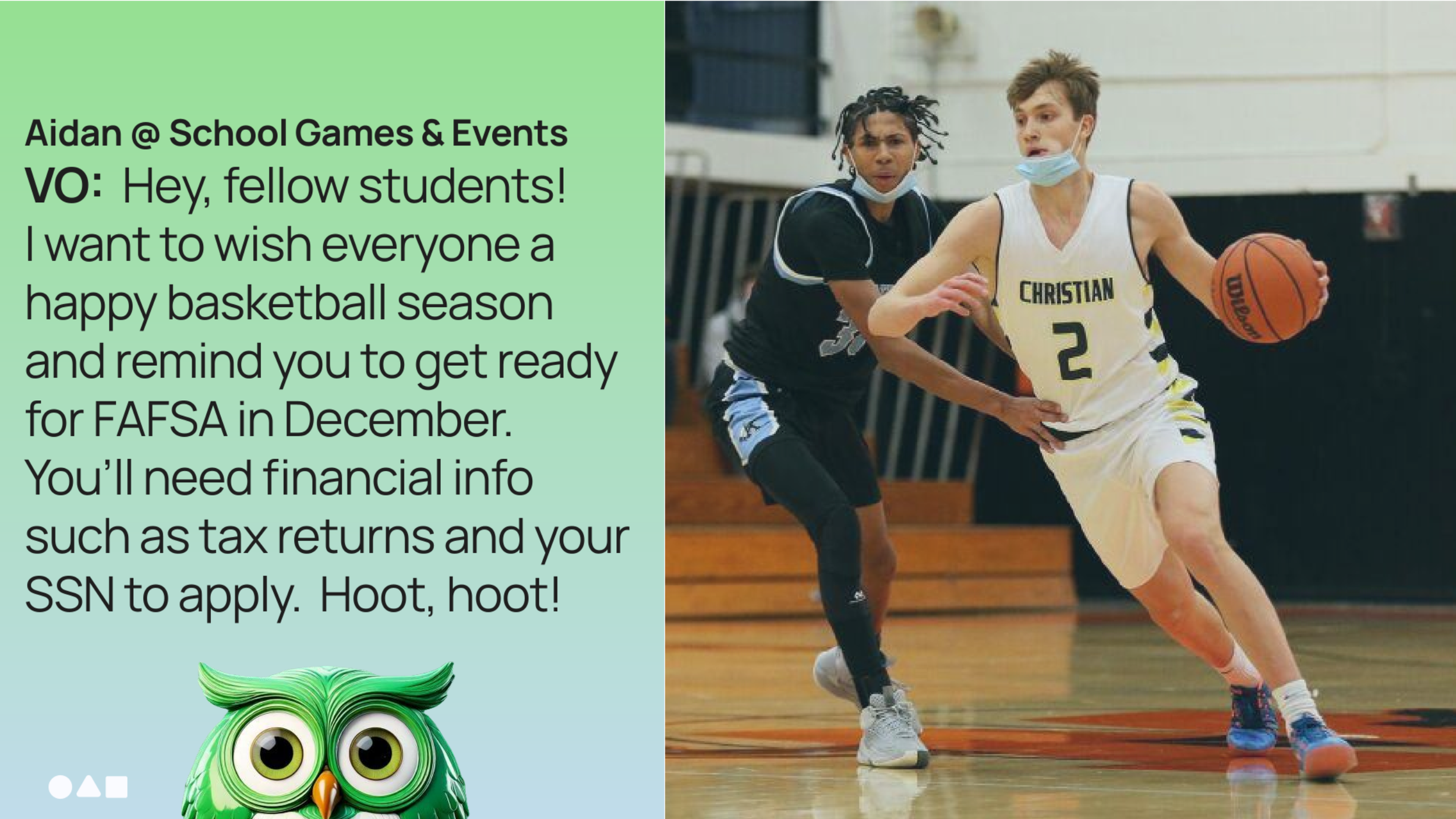
Aidan's VO During Surprise Appearance at School Basketball Game

FAFSA Billboard In The Wild

FAFSA ASMR Partnership with Miracle Forest

Aidan's Update for FAFSA Intro

Aidan's Update for FAFSA Section One

Aidan's Update for FAFSA Section Two

Aidan's Update for FAFSA Section Three

Aidan's Update for FAFSA Section Four

Aidan's Update for FAFSA Section Five
As a first-generation student, I am passionate about accessibility and improving educational experiences for future students. I thoroughly enjoyed adjusting FAFSA’s user experience, especially drawing from my personal experiences to enhance the project.